Trauma, trauma, trauma...
and the Unthought Known.

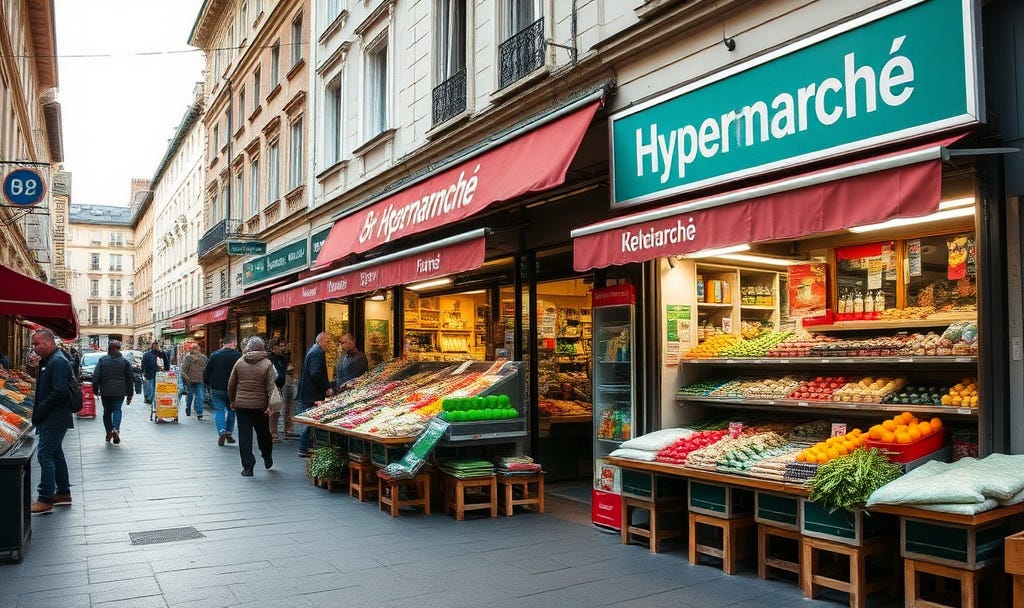
On a Sunday morning in Cherbourg, France, almost thirty years ago, I set out to do some grocery shopping with my “caddie” (a cart with wheels for groceries). There was not a lot of food at home aside from the fresh bread from the downstairs boulangerie.
As I walked the very quiet streets with my clanging caddie, it dawned on me that everything was closed. The few people out looked at me curiously – what could be my mission? I walked nevertheless to the deserted parking lot of the hypermarché - refusing to believe it could be closed, determined to see my errand through to its inevitable doom. Did I think that because it was me, an American, with no food in the fridge that the store would make an exception?
In the States (as we know) everything is set up to make it not only easy to shop whenever you want, but also with a smile, bagging your things into multiple plastic bags, and offering you the ten percent off store card, etc. etc. This was true thirty years ago, it’s still true today.
Maybe my belief in American consumer privilege pushed me on, ignoring the obvious signs that everything was closed. In any case I clanged back home empty-caddied. There would be no fresh food at home until Monday.
This may not seem traumatic to you – “first world problems” as they say. You are correct. Yet the reason I tell this anecdote is to introduce the notion of “trauma” at a granular, quotidian level, and that moving overseas can mean many days of tiny or not-so-tiny traumas. For some of my patients, it’s recurrent parking tickets on the streets of Nantes. Others can’t take out any cash because their card won’t work in the ATM. France is famous for its slooooow bureaucracy, and the customer is not king on this side of the pond.
I went home not with food that Sunday, but with the disconcerting and unfamiliar feeling of lack. Of course, I wasn’t in danger of starving (not in France!), yet not being able to meet our needs because the stores weren’t on my personal schedule was humbling, and yes – a bit traumatic.
These ordeals can cause feelings of helplessness, anger, or panic, feelings that harken back to our earliest childhood.
Donald Winnicott, a psychoanalyst famous for his work with children, wrote that when so-called tiny traumas feel very threatening, it’s often because they evoke something we have lived through before when we had little or no control over our environment.
We wouldn’t be frightened unnecessarily and illogically unless some part of us knew to interpret these things as terrifying – so terrifying, in fact- that we’re afraid we could fall apart. It’s crazy making, even if logically we know, as grown-ups, that there’s no real threat. This logic isn’t conscious. I knew there would be food on Monday, people can get by with just a card for payments, and parking fines can be paid.
When the emotional impact of an event outweighs its reality, it’s a sign that something else is going on.
Many people come into my office - expats or not – with a lot of information on their traumatic histories. There are family secrets finally divulged, death, divorce… there is alcoholism, incest – all the terrible things. Some decided to leave their home country to get away from all of it. They understand their motivations for moving included putting physical distance from the persons and places that felt harmful.
But geographical distance makes no difference to the unconscious mind. More importantly – nor does chronological distance. Our unconscious minds don’t care if it’s 1998 or 2014 or 2026. This is why in dreams all of the images, places and people are not synchronic. Inside of you, they are organized by affective coloration and meaning, not by chronology.
As time goes on, and the tiny quotidian traumas accumulate (as they will, as they do) another understanding surfaces.
It is not because you can provide a list of your traumatic events that you have overcome them. It is not because you “know why” you’re traumatized that you will not repeat trauma in your life.
That is to say, re-living the daily tiny-traumas as overwhelming and unbearable is a way of keeping the trauma alive, though, of course, you don’t wish to do this. It’s an unconscious process, and one that makes a lot of sense.
We try to master things we can’t understand or control. Things that overwhelm and frighten us will get “played out” in different scenarios as an attempt to master them. They will be repeated. Freud called this the repetition compulsion.
We do not, in sessions, say “oh, this (your current sadness, anger, etc.) is because of this (your father drank).” That would be terribly reductive, and unhelpful.
The unconscious doesn’t really care about the drinking, per se. It cares about the strange way your father would stare at the wall or you having to tiptoe around his moods. It cares about the stage of psychological development you were trying to master at age three or eight or twelve. It cares about what it felt like to live in this sort of atmosphere. What interests us, in psychoanalysis, is how these adaptations made you who you are today; how the imprint, over time, of growing up in these spaces has possibly made parking tickets absolutely unbearable.
Others are mystified by their overeating, going after inappropriate partners, panic attacks… because they tell me they had a “perfectly decent childhood.” There is therefore, in their logic “no good reason” for their behavior. Sometimes this brings terrible guilt.
This is missing the point. The point is your unconscious mind is asking you to master something – and that something is not quite available to you, it has become repressed. At age four or eight you didn’t have the capacity to align your affective experience with logical and considerate thought.
This isn’t hopeless, and you are not condemned to repeat past cycles of trauma. But breaking free of them can often mean a separation from the past that may seem more painful and intimidating than maintaining the status quo. The word “seem” here is important… because in reality, psychological growth will bring you resilience that will make the world and its inevitable chaos less frightening.
Psychoanalysis or analytically oriented therapy is a way of giving yourself a wide berth for discovery. It comes from the inside-out; it doesn’t ask for timetables or methods or homework, it’s aligned with our inner world. Instead of seeking change by applying schemes and procedures, you connect to your own solutions and resources, your own inner knowing. The process allows you to learn to trust yourself as you get to know yourself better. We suppose that you know yourself better than anyone else can, and you already have what you need to break the cycle of trauma and live a creative, authentic life.
This taps into what Christopher Bollas calls the unthought known. The trauma we know about can be “thought” outright. What’s unavailable to conscious thought is how these traumas have impacted us, and continue to influence daily life. And - it takes a lot of energy to repress and relive trauma on a daily basis.
It’s possible to imagine how that same energy could be made available to you for actual living, actual creative thought – not rumination, not repetition (of bad partners, shopping impulsively… whatever it is).
Psychoanalytic therapy is about freeing your energy to be on your own side. It’s about discovering tools and treasures you didn’t know you had. And yes, it takes some time.
We can learn to swim or drive fairly quickly, but to do it well and naturally, without fear, will take more than a few weeks. Learning to live with yourself well, over time, means allowing yourself to go slowly.
After about thirty years here, I am still learning how to be “French,” even if officially on paper, I am “French”. I now know where to find food on a Sunday morning (only until 12h30 because after that – good luck!) and how to navigate a system that doesn’t facilitate shopping for my so-called convenience. I can confidently say this is no longer traumatic for me, and there is enough. Sitting here on a Sunday morning writing this with the cat on my lap – it is very quiet outside – and there is no need to rush.
Happy adapting, everyone.
Love it!! So true 😅